
Searching Washington County Civil Dockets
For Washington County State and Superior Court records, the online starting point is Georgia Courts E-Access. Understand what it is. The directory routes your search to a provider instead of searching every Georgia court itself. Coverage varies by court. You may need an account. Before opening the provider, have the court name, filing year, case number, and public party name ready to copy. Filings arrive through PeachCourt and eFileGA. But neither vendor login doubles as a full public civil docket.
When the online trail runs cold, call the Clerk of Superior Court. That is Megan Cramer, at 478-552-3186. The counter sits at 132 W Haynes Street in Sandersville. Hours run Monday through Friday, 9:00 a.m. to 5:00 p.m. Mail goes to PO Box 231, Sandersville, GA 31082, and the fax line is 478-553-9969. Ask the clerk whether a terminal or a paper alternative exists. The office does not publish its location for one.
- Read the court and case number from the filing.
- Use E-Access for participating State or Superior records.
- Compare service, answers, motions, settings, and judgment.
- Call the separate Magistrate or Probate counter when needed.
- Request the exact plain or certified document from its keeper.
Washington County Civil Docket Jurisdiction
Serious civil work in Washington County lands in Superior Court. Anything the law assigns to it goes there too. Its official page lists divorce, custody, child support, adoption, title to land, name changes, habeas cases, garnishments, family-violence or stalking protective orders, and other civil suits. A docket entry there might show the petition or complaint, service, answers, motions, hearings, orders, and the final judgment.
Chief Judge Robert S. Reeves and Judge Tommy J. Smith sit on the Middle Judicial Circuit. A name on an older entry can be stale. The judge at the next setting may differ. Trust the current notice. Per the county, attorneys have filed civil cases electronically since January 1, 2019. That mandate applies to filings. It does not turn the vendor login into a public record search.
Key distinction: A docket entry proves that an item was recorded. It does not replace the pleading, exhibit, order, or certified judgment behind it.
Inside a Washington County Civil Docket
A civil docket reads like a chronological register. Start with the case number, court, filing date, style, judge, case type, and status. From there, follow the service and filing entries in order. Washington County publishes no local case-number pattern or provider code legend. So copy the number straight from court paper. Or confirm it with the clerk. Guessing a prefix or a punctuation mark is how searches fail.
| Identity | Case number, court, filing date, style, and public roles. |
|---|---|
| Pleadings | Complaint or petition, service, answer, and amendments. |
| Settings | Date, time, judge, courtroom, hearing type, and resets. |
| Activity | Motions, orders, judgment, costs, and later entries. |
| Access | Document links, masked fields, restrictions, or clerk-only files. |
A free result can be just a case shell. Pulling the complaint, evidence, order, or judgment behind an entry may take an image or copy request. And a screen print is never a clerk-authenticated copy.
Washington County Civil Docket Split
State Court takes the civil matters not reserved exclusively to Superior Court. Magistrate Court keeps Statements of Claim. It also handles dispossessory cases, garnishments, abandoned-property proceedings, and similar small civil work. Probate Court runs estates and guardianships from its own Room 106 counter. So the right clerk turns on the case type. The parties or a dollar amount alone do not settle it.
| Court | Local civil work | Access |
|---|---|---|
| Superior | Major, domestic, and land-title matters | 478-552-3186 |
| State | Non-exclusive civil matters | 478-552-3186 |
| Magistrate | Small claims, dispossessory, garnishment | 478-552-3591 |
| Probate | Estates and guardianships | 478-552-3304 |
Magistrate publishes a current Statement of Claim limit of $15,000, rising to $25,000 on January 1, 2027. The threshold helps route a claim. It does not guarantee that every dispute under the limit belongs there. Confirm jurisdiction before filing.
Civil Case Types on the Docket
On the Superior civil docket you will find domestic cases, land-title disputes, protective-order work, garnishments, and general suits. State Court covers the non-exclusive civil gap. Magistrate dockets carry their own vocabulary: Statement of Claim, dispossessory, garnishment, interrogatories, FIFA, and writ of possession. Probate proceedings run on a separate civil-record path.
Civil flow: Complaint or Petition › Service › Answer › Motions › Setting › Hearing or Trial › Order or Judgment
No Washington County case is required to hit every step. A default, dismissal, settlement, amendment, appeal, or post-judgment collection entry can reshape the sequence. Always read a date together with its entry text. A motion asks the court for something. An order records what the judge decided. A filed motion tells you nothing about whether it was granted.
- Service
- Formal delivery of the filed claim or petition.
- Answer
- The responding party's filed response.
- Setting
- A scheduled hearing or trial event.
- Judgment
- The court's decision recorded in the case.
Washington County Civil Answer Clocks
Washington Magistrate Court gives a defendant 30 days to answer. That clock runs after a Statement of Claim is filed and served. Paying court costs into the registry can add 15 days. Once an answer is filed, the court says a hearing follows within 30 days. The filed service date drives that whole timeline, so it matters most.
Dispossessory cases move faster. The published answer period is seven days. If an answer comes in, the hearing lands within seven to fourteen days. Restraining, TPO, and family-violence stay-away requests do not belong in Magistrate. Those route to Superior Court instead. With a live deadline, rely on the filed paper. Follow the clerk's instructions, not a general schedule.
Note: A general recurring court session does not set the deadline or hearing date in a specific Washington County civil docket.
Civil Docket Settings and Hearings
A setting is a court event on the calendar, not a ruling. A Washington County civil docket entry tells a story in parts. Read it for the date, time, and judge. It also names the courtroom and the hearing type. A continuance or reset only moves the event. It does not dismiss the suit or erase a filing. State Court asks civil litigants to call 478-552-3186 to schedule a civil hearing.
Superior Court publishes recurring sessions, but those dates do not prove an individual hearing date. Confirm the current setting with the responsible clerk and the latest notice. The Washington County court dates process explains the reason. A case-specific entry outranks the county event calendar or a broad court term.
Magistrate holds recurring sessions on Mondays and Wednesdays. Those days say nothing about one civil case. Match the case number and type on the docket. Then ask the clerk whether a reset, courtroom change, or later notice controls.
Washington County Civil E-Filing
The Washington County Superior and State pages name PeachCourt for attorney civil e-filing. The portal screen shows email and password fields, login, password help, and registration. That interface receives filings. It does not prove the public can search every Washington County civil docket there. The PeachCourt filing gateway displays the official page itself. It carries no private case or personal data.

The roles stay separate here. E-Access handles a participating public search, while the clerk supplies a filed document that a result does not display. Filing access and reading access are different functions. The county pages publish no vendor fees.
Washington County Civil Filing Limits
Washington Magistrate Court links eFileGA for civil filing. The county also warns about garnishment answers. Those cannot currently be e-filed. That local limit matters more than a vendor's general service list. The official eFileGA gateway documents the filing channel, not a public case result.
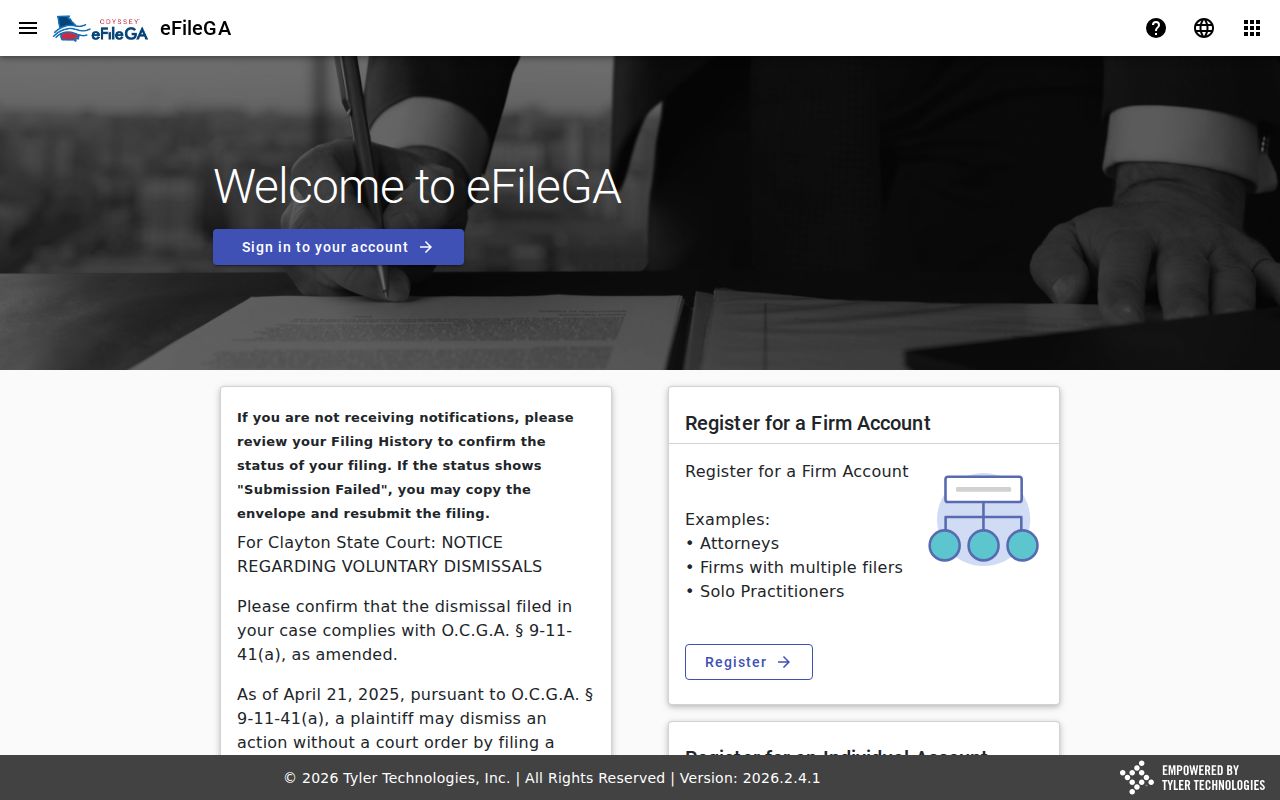
Call Magistrate at 478-552-3591 to confirm the allowed method, fee, service step, and hearing route. Do that for the exact pleading. The published fee for a Magistrate small claim, dispossessory, or garnishment is $95. That includes service for one defendant or garnishee. Added service charges apply where applicable. Ask the clerk to total the cost before you file.
Civil Docket Access Rules
Georgia starts with a presumption of public court records, with targeted limits. Uniform Superior Court Rule 21 sets out a motion and order process for limiting access. Protected identifiers may be masked. Family-violence, adoption, juvenile, and sealed material may not display like an ordinary civil suit.
If E-Access lacks an entry or image, use the clerk. Reach the clerk by phone, counter, mail, fax, or email. Ask about a public terminal or paper alternative. Do not assume one exists at a named place. For Magistrate call 478-552-3591; for Probate call 478-552-3304. A precise Georgia public-record request should name the court, record, date range, and case number.
Washington County charges $1 per page for a plain Superior copy. A certified Superior or State copy costs $2.50 for the first page. Each added page is $0.50. Card copy payments carry a $10 minimum. Confirm total cost, format, delivery, and access status before ordering. Missing online content does not mean the whole case is sealed.